
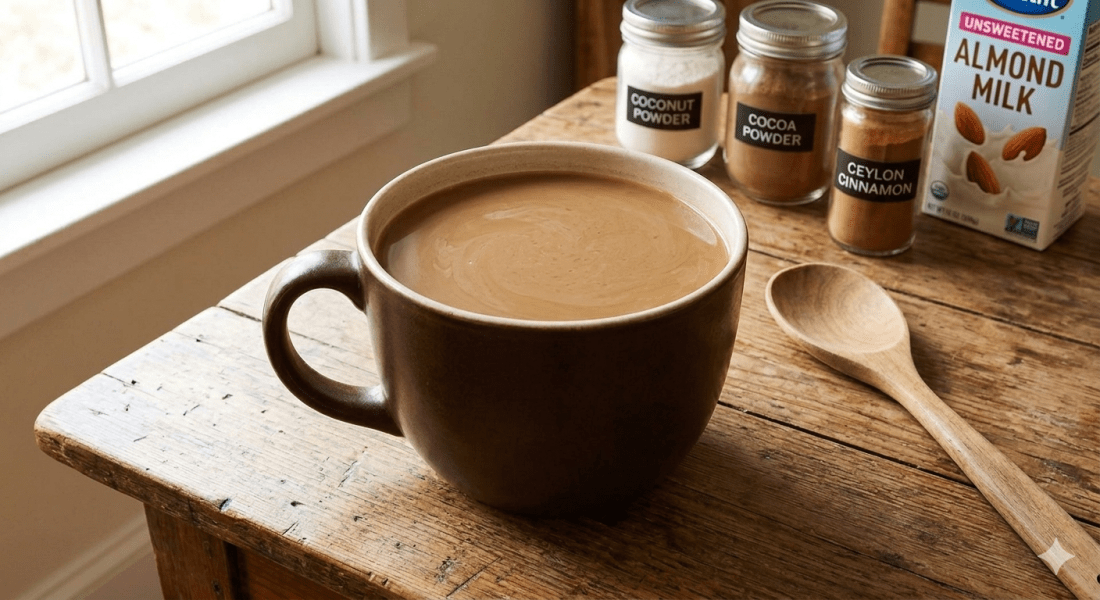
The “Candy Bar” Coffee: How to Bridge Your Fast Without the Bitter Aftertaste

Candy Bar Coffee

Black coffee is gross… I said it…

I absolutely cannot stand black coffee. If “brown bitter water” is your jam, then read no further… but to all my kindred spirits who think a creamy, decadent cup of joe is the only way to kick off a 10k-step day, I have something special for you.

This recipe is the ultimate “metabolic bridge.” It is low enough in net carbs to keep your insulin levels stable and keep you in ketosis, unless you follow the strictest “water-only” fasting rules. It also provides the healthy fats needed for brain fuel and thermogenesis.

It’s not just coffee; it’s a metabolic tool and a strategic deposit into your nutritional bank account.

The Candy Bar

  • 3 cups of high-quality Coffee
  • 35 ml Unsweetened Almond Milk (High-Calcium)
  • 1/2 TBS Stevia (or to taste)
  • 1 TBS Coconut Powder
  • 1.5 tsp Cocoa Powder
  • 1/2 tsp Ceylon Cinnamon

IngredientThe “Super You” Benefit
Coconut PowderHigh in MCTs for immediate energy and thermogenesis.
Cocoa PowderPacked with Polyphenols for heart health and mood.
Ceylon CinnamonHelps regulate Blood Sugar and insulin sensitivity.
Almond MilkProvides a Calcium Deposit for bone density.

Why These Ingredients Matter

1. Coconut Powder (The Metabolic Engine)

Coconut is rich in Medium-Chain Triglycerides (MCTs). Unlike long-chain fats, MCTs are sent directly to your liver to be used for immediate energy. This promotes thermogenesis—essentially turning up your body’s internal furnace to burn fat while you’re still in your fasting window, and providing immediate brain fuel [1].

2. Cocoa Powder (The Vascular Flush)

Beyond the rich flavor, cocoa is packed with flavanols that improve Flow-Mediated Dilation (FMD). This helps relax your blood vessels and improves circulation, which is critical for heart health and muscle recovery. It’s a a great pre-workout “deposit” if you’re headed to the gym [2].

3. Ceylon Cinnamon (The Blood Sugar Guard)

Not all cinnamon is created equal. I use Ceylon (the “true” cinnamon) because it is a powerhouse for insulin sensitivity. It keeps your blood sugar from spiking by helping your body process glucose more efficiently. This ensures your morning cup supports stable blood sugar levels throughout the day and doesn’t kick you out of your fat-burning state. [3].

4. High-Calcium Almond Milk (The Bone Deposit)

By choosing an unsweetened almond milk fortified with calcium (look for ~450mg per cup), you are making a literal “Bone Deposit.” High-intensity training can cause the body to “rob” calcium from your bones if blood levels drop; this pre-exercise calcium feeding protects your skeletal density for the long haul [4].

The “Super You” Final Proof

By the time I finish this cup, I’ve fueled my brain, protected my bones, and primed my metabolism—all before my first solid meal. It’s about re-engineering the frame from the inside out.


Sources

[1] Weight-loss diet with MCTs leads to greater energy expenditure – PubMed

[2] Cocoa Flavanol Cardiovascular Effects Beyond Blood Pressure Reduction – PMC

[3] Cinnamon: Potential Role in the Management of Insulin Resistance – PMC
[4] Nutrition and Athlete Bone Health – PMC

The Root of Resilience: Why Ginger is a High-Performance Staple

The Science of Ginger: A Natural Powerhouse for Modern Wellness

Ginger has been a cornerstone of traditional medicine for centuries, but modern science is finally catching up to why this root is so effective. It isn’t just a flavor enhancer; it is a bioactive tool that addresses several of the most common health challenges we face today—from chronic inflammation to digestive distress.

1. Cooling Chronic Inflammation

Inflammation is the body’s natural defense against injury or infection. However, when it becomes chronic, it acts as a silent driver for serious conditions like arthritis and heart disease. Ginger contains potent compounds called gingerols and shogaols. These act as internal “coolants” by inhibiting the production of pro-inflammatory cytokines, helping to keep the body’s immune response in a healthy balance [1].

2. Natural Relief for Nausea and Pain

One of ginger’s most celebrated benefits is its ability to soothe the digestive system. It effectively blocks the chemical signals in the brain that trigger nausea, making it a reliable remedy for motion sickness and post-treatment recovery [2].

Beyond digestion, those same gingerols offer analgesic (pain-relieving) effects. Studies show that regular ginger consumption can be effective for managing exercise-induced muscle soreness and joint pain [3].

3. Strengthening the Foundations: Immunity and Brain Health

Ginger supports the body’s long-term resilience through:

  • Immune Support: Rich in sesquiterpenes, ginger provides antimicrobial properties that help the body fend off common viruses [4].
  • Cardiovascular Care: By assisting the liver in regulating cholesterol production, ginger helps maintain clearer pathways for heart health [5].
  • Cognitive Protection: Its neuroprotective properties help shield brain cells from oxidative stress, a key factor in maintaining memory and focus as we age [6].

4. Maximizing Your Digestion

Effective digestion is the bedrock of energy. Ginger stimulates the production of vital digestive enzymes, which ensures that the food you eat is broken down and absorbed efficiently. This reduces the likelihood of uncomfortable bloating, gas, and sluggishness after meals [2].


Integration and Safety

Whether used fresh in a smoothie, steeped as a potent tea, or taken in a concentrated supplement, ginger is highly adaptable.

A note of caution: because ginger can have natural blood-thinning properties, it is important to consult with a healthcare professional if you are currently taking anticoagulants or other specific medications.


References

[1] Anti-Inflammatory and Antioxidant Activities of Ginger – IntechOpen

[2] The Effectiveness of Ginger in the Prevention of Nausea and Vomiting – PMC

[3] Clinical Trials on Pain Lowering Effect of Ginger: A Narrative Review – PMC

[4] Ginger for Colds: How to Use Ginger for a Sore Throat – Medical News Today

[5] Plasma Cholesterol-Lowering Activity of Gingerol- and Shogaol-Enriched Extract – ACS Publications

[6] Zingiber officinale Improves Cognitive Function of Healthy Women – PMC

The Myth of “Like Cures Like”: Why Cottage Cheese Actually Fights Cottage Cheese Thighs

We’ve all heard the health “wisdom” that sounds catchy but makes zero sense. “Drink more water to lose water weight!” (True). “Eat fat to burn fat!” (Also true, within reason).

But then, a question popped up in my feed: “If water helps flush out water, and fat helps flush out fat, does cottage cheese help get rid of cottage cheese thighs?”

It sounds like a joke. But biologically speaking, the answer is a resounding YES. Just not because of the name. Let’s look at the “Master Ledger” of why these strategies actually work.

1. Water to Water: The “Flush” is Real

When you’re dehydrated, your body enters “famine mode,” secreting Vasopressin (Antidiuretic Hormone) to cling to every ounce of fluid [1]. This causes the scale to spike and your joints to feel stiff.

  • The Science: Drinking water suppresses Vasopressin and signals the kidneys to excrete excess sodium. Since sodium “pulls” water into the extracellular space, flushing the salt flushes the bloat [2].
  • The Case Study: After a high-sodium Saturday, my scale hit 158.4 lbs. I didn’t gain 2 lbs of fat overnight; I gained a “Sodium Debt.” Sunday is for 100oz of water to “dilute the vault.”

2. Fat to Fat: The Metabolic Key

We were told for decades that fat makes you fat. The data says otherwise.

  • The Science: Healthy fats—like the MCTs in my “Candy Bar” coffee—promote satiety and thermogenesis. Specifically, Medium-Chain Triglycerides are sent straight to the liver for energy rather than being stored as adipose tissue [3].
  • The “Super You” Move: I use coconut powder to bridge my morning fast. It keeps my insulin low and my brain fueled, allowing my body to continue burning its own stored fat for energy.

3. Cottage Cheese to “Cottage Cheese” Thighs: The Recomposition Revelation

Cellulite (the “cottage cheese” look) isn’t just fat; it’s a structural failure. It happens when fat cells push through a weakened dermal matrix—the “netting” of your skin.

  • Casein Protein: Cottage cheese is 80% Casein, a slow-digesting protein that provides a 6–8 hour “drip” of amino acids to repair muscle and skin [4].
  • The Leucine Trigger: It’s loaded with Leucine, the specific amino acid that triggers Muscle Protein Synthesis (MPS). Clinical trials show that Leucine-rich diets help maintain lean mass while targeting fat loss [5].
  • The Result: Today, my thighs are symmetrical at 24.5″. By building the muscle density underneath and using the amino acids to strengthen the skin “netting,” the surface naturally smooths out.

🛡️ Science vs. Superstition: The “Super You” Sidebar

On social media, people often fall for the Doctrine of Signatures—the ancient belief that foods that look like body parts are meant to heal them (e.g., “Walnuts look like brains”).

The Distinction:

  • The Superstition: Eating cottage cheese because it “looks like” the problem.
  • The Science: Eating it because its Casein and Leucine content are the exact raw materials required to rebuild the dermal matrix and muscle density.

The Final Proof: The Belt Doesn’t Lie

While the scale was “heavy” today at 158.4, I officially hit the 3rd hole on my favorite belt. On January 1st, I could barely fasten the 1st hole. That is 2 inches of real estate gone from my waist while my legs got stronger. That’s not a “diet”—that’s re-engineering the frame.

Stop chasing the number. Start feeding the density.


Sources

[1] Physiology, Vasopressin – StatPearls – NCBI Bookshelf

[2] Vasopressin regulation of renal sodium excretion – James D. Stockand

[3] Weight-loss diet with MCTs leads to greater energy expenditure – PubMed

[4] The Role of Casein Protein in Muscle Protein Synthesis – PMC

[5] Leucine may help to burn fat but spare muscle wastage: Pilot study – Nathan Gray